

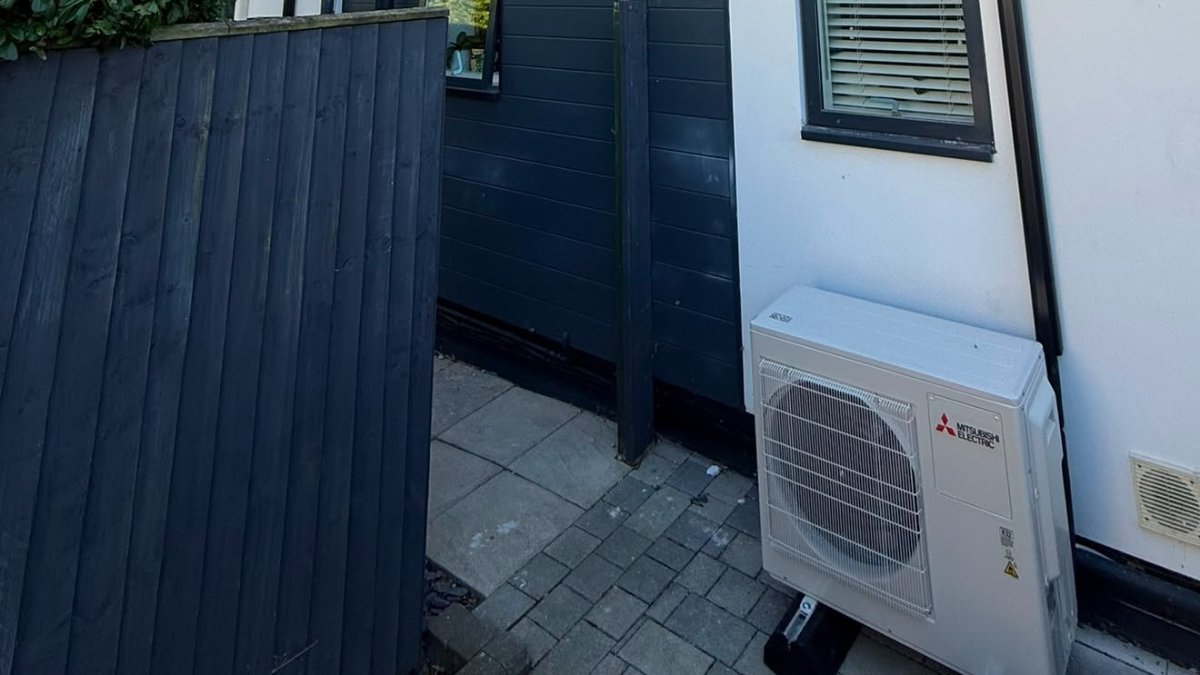
Planning permission is one of the first questions we’re asked at survey. The good news: for most houses in Cheltenham, Gloucester and Tewkesbury, a wall-mounted air conditioning system doesn’t need a planning application. There are some exceptions, though, and it pays to know them before you choose where the outdoor unit goes.
This guide covers houses in England. It’s general information, not legal advice. If your home is listed, in a conservation area or a flat, check with your local council before work starts.
The short answer
- Most houses: usually no planning application needed. The outdoor unit is normally covered by permitted development rights.
- Listed buildings: you’ll almost always need listed building consent.
- Conservation areas: often fine, but where the outdoor unit goes matters.
- Flats and apartments: permitted development is more limited, and you’ll usually need the freeholder’s or management company’s permission too.
Why most air conditioning counts as permitted development
Modern split air conditioning systems are air-to-air heat pumps: the same unit that cools your room in July heats it in January. In England, air source heat pumps on houses fall under Class G of the permitted development rules, which means you can install one without applying for planning permission as long as you stay within the limits.
Those rules were relaxed on 29 May 2025. The main changes:
- The old rule that the outdoor unit had to be at least 1 metre from your boundary has gone.
- The maximum outdoor unit size went up from 0.6m³ to 1.5m³, which covers virtually every domestic unit, including multi-split outdoor units serving several rooms.
- Detached houses can now have up to two outdoor units.
- The installation must meet the MCS 020 noise standard, which checks that the unit won’t be too loud at your neighbour’s nearest window.
At survey we look at where the outdoor unit can sit quietly and neatly: often a rear or side wall, a ground bracket, or a flat roof out of sight.
Listed buildings
Cheltenham has one of the highest concentrations of listed Regency buildings in the country. If your home is listed, fixing an outdoor unit to the building or drilling through historic walls almost always needs listed building consent from the council, even if planning permission isn’t needed. Carrying out work without it is a criminal offence, so don’t skip this step.
It doesn’t mean air conditioning is off the table. Consent is often granted when the outdoor unit is out of sight (a rear garden, a basement well or a later extension) and the pipe route avoids original features. We can help you plan a route that gives your application the best chance.
Conservation areas
Large parts of central Cheltenham are conservation areas, including Montpellier, Pittville, Lansdown and The Park, as are parts of Gloucester city centre and historic Tewkesbury. In a conservation area, an outdoor unit generally isn’t permitted development if it would be fixed to a wall or roof that faces a road. Put it on a rear or side wall that doesn’t face the street, or on the ground in the back garden, and you’re usually fine.
Not sure if you’re in a conservation area? Each council publishes maps:
- Cheltenham Borough Council: conservation area maps on its planning pages
- Gloucester City Council: conservation area appraisals
- Tewkesbury Borough Council: conservation area list
Flats and apartments
Permitted development rights for heat pumps are written mainly for houses. If you live in a flat, the safest route is to:
- Check your lease. Most leases need the freeholder’s or management company’s written consent for anything fixed to the outside walls or balcony.
- Ask the council whether a planning application is needed for your building.
- Think about building approval. Some blocks also need approval for drilling through external or fire-separating walls.
Balconies, flat roofs and communal plant areas often make good spots for an outdoor unit. For blocks and developments we can design one system across several apartments. See our multi-split air conditioning page.
Other things worth checking
- Article 4 directions: some areas have extra restrictions that remove permitted development rights. Your council’s planning pages list them.
- Rented homes: tenants need the landlord’s permission; landlords should keep a record of the installation and servicing.
- Neighbours: not a legal requirement, but a quick word before installation goes a long way, especially if the unit will be near a shared boundary.
- Electrics: the electrical connection must comply with Building Regulations (Part P) and be carried out by a qualified electrician.
Frequently asked questions
Do I need planning permission for air conditioning in Cheltenham?
For most houses, no. A standard wall-mounted system is usually permitted development. Listed buildings, outdoor units on road-facing walls in conservation areas, and flats are the main exceptions.
Can I put the outdoor unit on the front of my house?
Outside a conservation area, usually yes, as long as it meets the noise standard. Inside a conservation area, a unit on a wall facing the road normally needs planning permission, so we’d suggest the side or rear.
How close to my neighbour’s boundary can the unit go?
Since May 2025 there’s no fixed 1 metre rule in England. What matters is noise: the installation has to pass the MCS 020 noise check at the neighbour’s nearest window.
Will you check this at the survey?
Yes. We look at your property, suggest the best position for the outdoor unit and tell you if anything needs checking with the council before you commit.
Book a free survey
We install air conditioning across Cheltenham, Gloucester, Tewkesbury and the rest of Gloucestershire. Book a free, no-obligation survey and we’ll tell you exactly where the units can go and what it will cost. Call 07376 893780 or book your free survey online.
Want a rough idea of price first? Read our air conditioning cost guide.
